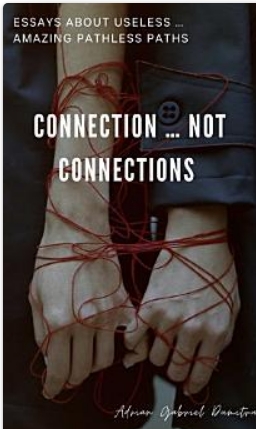
Adrian Gabriel Dumitru’s CONNECTION … NOT CONNECTIONS is a thoughtful and introspective exploration of what it truly means to form deep, meaningful connections in a world that often prioritizes superficial networking. This collection of essays acts as a form of self-therapy for the author, who embarks on a journey to answer the questions that have long troubled him—questions that many of us ask but rarely attempt to answer with such honesty and depth.
At the core of this book is Dumitru’s attempt to define the elusive concept of “connection.” What does it mean to genuinely connect with another person? How do we differentiate between authentic relationships and those that are built on convenience or social obligation? These reflections are not just philosophical musings; they are deeply personal, born from the author’s desire to understand the difference between fleeting interactions and true, lasting bonds.
Beyond these central questions, Dumitru confronts some of the most challenging aspects of human relationships, grappling with issues like “Is monogamy possible?” and “Can we manage our fantasies while in a relationship?” These inquiries invite readers to reflect on the nature of commitment, desire, and emotional honesty in their own lives. The author doesn’t shy away from examining the tension between our desires for connection and the complex emotions—passion, obsession, and fantasy—that can both enrich and complicate relationships.
One of the book’s most striking elements is the author’s raw exploration of passion and obsession—those intense forces that often drive our most meaningful relationships, but that can also lead us down “pathless paths.” The author deftly examines how these emotions impact both the individual and their relationships, blending personal insight with philosophical reflection in a way that feels deeply relatable.
For anyone seeking a meaningful exploration of relationships, connection, and self-awareness, CONNECTION … NOT CONNECTIONS is a must-read. Dumitru’s ability to merge introspection with universally relevant questions about feelings and desire makes this book a transformative journey—one that will resonate with readers long after they turn the final page.
CONNECTION … NOT CONNECTIONS: essays about useless … amazing pathless paths
Four questions kept repeating into my mind, for a long, long time … and i’ve decided to write the book called “Connection … not connections” …. as a reply … first of all for myself. Yes … I prefer to write … cause is a much better way to understand my perceptions. …. and i already do it by a long time, all being soft of a self therapy … defining all my thoughts… even if most of them are so, so contradictory… The number one question is what the hell is this weird concept called … connection?! … and what is its meaning?! Well … more i think about it … i become more and more confused. I have moments when i believe i had found the real truth … but also moments when i am just disappointed of my disability of penetrating deeper the secrets of life. The only real thing that i know for sure … is that the spiritual connection is the one that can help us … get rid of all related with the illusory of life. And going deeper …. seeing all sorts of connections … i ask again … what is a love story?! What is its meaning?! Why we feel so, so changed when we find that person which we call …. soulmate?! What is happening with us … while being into such a connection …. but also why the hell we realise into the end that all was illusory?! I smile … but … again … no matter what ideas would come into my mind … i still feel that actually this is not really a path to follow. And i’m writing that … after personally testing all what i am saying … I continue my meditations and into my mind appears a much weird idea … revealed by the people which are feeling good together … but still after an experience of life … after being involved into lots of relationships… knowing the fact that after a while …. even the most beautiful love story becomes boring …. and being realistic enough … they start allowing themselves to practice the art of being a swinger. And i will not bother to explain the concept… cause everyone knows it … but it’s probably a way of accepting… that we actually need to taste more than one energy. They simple can’t stay …. just in one connection… adoring to occasionally taste other souls too … The theory itself … looks so, so weird. … and immoral of course. But … on the other hand … can be accepted consciously… or … by force … Cause … yes … cheating is not immoral … but a simple result of the fact the energy of the connection with the partner … is not anymore all we wanted … and actually needed for having the soul fulfilled with beautiful vibes. So … i could even say that the swingers are actually… wise persons. Many would judge me … for saying such a thing … but … But i continue my analyses … and i dare to ask myself … how the hell lives a monk alone into the monastery?! How can a human being live without a partner of life?! Is that really possible for us to live without the connection of the opposite sex?! I found that as … weird too … but somehow i’ve felt that life itself has many stages of evolution. Some … find themselves into a relationship … which gives them all they ever dreamed about. All the necessary energy comes from that story … making them happy all the time. Others … being honest enough … with a lot of experience of life … admitting the truth that only one type of energy is never enough for their souls … go on the path of allowing themselves to taste other souls too. … at least from time to time. And i see the monk … but even if in my perceptions this was a too weird scenario … i start to realise that the monk is actually chasing for the connection with the absolute. He was most probably like all the other humans … having desires, wishes, lots of values in common with the society… but abandoned all seeing its ephemerality. The new purpose was only to chase for the infinite connection … meanwhile … into the real world … practising the solitude… But even if i write all those questions … with an answer to each of them …. i know i did not find the real answer. No … And it’s even worst … cause i feel that i am too far away … of the absolute truth, the result being that into my real life … i am actually in connection… in connections … or disappointed of all … i see myself practicing … the solitude… disconnecting from everything and everyone … having the hope that … the real path to follow in life will be revealed to me.
Adrian Gabriel Dumitru’s INFLUENCING AND BEING INFLUENCED takes readers on a exploration of the subtle and often unseen forces shaping our lives.
The author dissects the psychology of influence, weaving together the complexities of how we impact and are impacted by the world around us. This book is not just a study of influence—it’s a guide to understanding the ebb and flow of energy, thought, and expectation in both personal and professional level.
With his assertion that we can influence reality by expecting something totally different, he brilliantly highlights how can actively change our realities by shifting our mindset.
One of the strengths of the book is the author’s ability to translate complex psychological and philosophical ideas into accessible language. From the first chapter, the reader is hooked by his clear, engaging style and the way he relates abstract concepts to everyday life. Whether you’re interested in personal development, leadership, or simply becoming more mindful of how you’re being influenced, this book offers valuable tools to enhance your understanding.
This a must-read for those looking to enhance their effectiveness and personal growth in any leadership role.
Overall, INFLUENCING AND BEING INFLUENCED invites you to reframe how you perceive and interact with the world. Dumitru’s engaging style and insightful observations make this book a captivating journey into the endless dance of influence.
Influencing and being influenced: a non ending story (ESSAYS – contradictory perceptions about love, philosophy, spirituality, motivation … and life in general Book 48)
“In many of the occasions in life, we see everything in a simple dogmatic way. We are used with different kinds of results and believe that these represents the only case scenarios that can happen. We want something else, but don’t really believe that life can bring us the … goodies. We predict the future, according to the past. But you know, same story, with the same elements can also have a different result than we are used to expect. We can influence reality … just by expecting something totally different that we used to have. For example … there are cases when the Universe is sending us the same lesson on and on and on … till the day when we understand that we need to do things differently to get a different result … and improve everything happens. Sometimes we are good theoreticians, sometimes we can’t even see clearly reality and understand the meaning of the events … especially the negative ones. But having optimistic standards can help us break any problem … and in the end influence the energetic field of any situation, event .. or even the energetic field of other people. And when i use the term … energetic field … i mean the environment itself, with all its attributes that defines everything in a certain way. I can give a simple example. I was in a morning in my garden, reading a book. I was on a chair, in a specific place from my garden … and i use to use that place by almost 10 years. From that point, i see the beauty of my garden in a specific way, but because it was a very hot day, and the sun came in that point, i had to move the chair in a different place from the garden, not to stay anymore in the sun. I was amazed. I almost saw a different garden from that position. I loved it … but everything was a totally different perspective. This was a simple case scenario … seeing even something beautiful, from a different angle and almost believe is something else. But in theory, and even in practice, we can have even negative perspectives totally metamorphosized into positive one. We can change the script of any scenario, by re-evaluate everything … just by expecting of getting a positive result … the one we desire. This is how, only by having an opened mind, ignoring the statistical datas from your past, the one that defines the probability of having a certain scenario … we can actually influence, but also change the reality itself. And what we define as miracle … is in fact just changing the believe into the fact that … life can be also the way we dare to dream. Truth be told, the reality can be created or even re-created in any way we want it to happen. All we need to do is to connect to that energetic field, which actually means … be one with the present moment … and expect as everything should happen in a specific way that you want. Even the miracle itself is just a different result … the one that we had in mind and wanted. So … realities can be defined, redefined, but also written in any specific way. A hollywoodian movie … has amazing scenes and all the scenes are a telling the details of the story … so that it will have a powerful message, but also powerful impact on you. You connect with the reality of those scenes, but most probably the same scene was filmed by 5th – 7th … even 15th times, till they considered they had the perfect one. The same way, certain events could be redefined by us, just by meditating, finding the best solution for that event … and then implemented in the real life. And try … and try again … till the moment it just happens. And the life can look like a hollywoodian movie also … by using the power of re-evaluation, re-defining and keeping an opened mind, expecting all the time positive scenarios for our lives. We are the creators of our reality … by conscious or unconscious thoughts … but in the end we should keep in our mind that what looks like a negative script, might be just a life lesson … not finding yet the right path in life … but every scenario can be re written in the way we want it to happen. The key?! I mean the key of getting out of the labyrinth … is connecting to that reality … that energetic field … and have great expectations from it. So … even if you don’t know it yet … there is an art of influencing reality and you can learn it.”
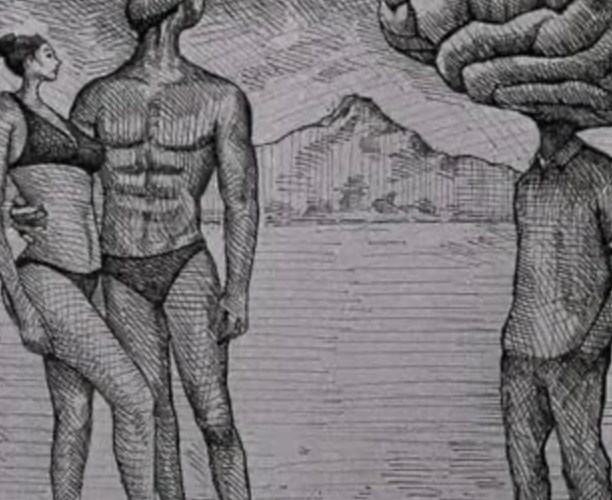
In Mr. & Mrs. FREUD, Adrian Gabriel Dumitru takes readers on a compelling psychological journey through the complex dynamics of love, intimacy, and the human mind. Drawing from Freudian theory and blending it with his own reflections, the author weaves a narrative that is part philosophical musing and part psychological exploration.
One of the most fascinating aspects of this book is Dumitru’s willingness to grapple with both the beauty and frustrations of love. Having sworn off writing about love after twenty previous books on the subject, he returns with a fresh, ironic awareness—this time through the metaphor of psychological “games” that lovers often play. Freud, with his groundbreaking theories on the subconscious, serves as the perfect backdrop for this investigation into the mental acrobatics that couples often engage in, knowingly or unknowingly.
Screenshot
What makes this work stand out is the accessibility of the complex psychological theories Dumitru explores. The writing is insightful without becoming overbearingly academic, allowing both the seasoned psychology enthusiast and the casual reader to find value in his reflections. Dumitru deftly navigates concepts like repression, projection, and defense mechanisms while keeping the tone personal and relatable.
At its core, Mr. & Mrs. FREUD is about the delicate balance of power and vulnerability that comes with love. The author captures the paradoxes of human relationships—the desire for intimacy paired with the need for autonomy, the games people play to protect themselves, and the unconscious battles for control.
If you’ve ever found yourself intrigued by the psychology behind relationships, or if you’re simply a lover of thought-provoking, introspective writing, this book will resonate deeply with you. Dumitru’s musings are both poetic and grounded in psychological depth, making Mr. & Mrs. FREUD an engaging and enlightening read.
Mr & Mrs FREUD: in love… but still playing psychological games (ESSAYS – contradictory perceptions about love, philosophy, spirituality, motivation… and life in general Book 13)
“I’ve wrote many books about love … being in love, but also hating the concept of love … and even promised myself that i’ll never do that again … but … Well … into one point … after publishing 20 books of love essays … i’ve had a very serious discussion with myself and … Yes … i’ve said it again that i’ll not write again about love …. But … damn it … i just loved the concept. I loved all related to …. love. And even if i knew that a love story is many times … illusory … and might ruin completely our souls … destroying them forever … I’ve continued to write my perceptions about the subject. The funny thing is that … promising myself i’ll never be again into a love story … i’ve started to analyse the couples i saw on the stage of my life. And what was intriguing me the most was why a man and a woman … even when the love between them is so damn obvious… still do stupid things … which are actually ruining all?! Why if both of them are in love of each other …. what the hell could be the meaning of the non sense psychological games we are doing?! And even worst … why do we see very intelligent people … playing so, so stupid on that stage of a love story? Why do they need to do stupid things?! Why they jump from love to hate so easily?! Also … why the hell … even the ones knowing a lot about psychology … don’t do the right things?! And had many occasions to see people which I’ll generally define as Mr and Mrs Freud … practicing the nonsense into a love story …. on and on and on. The final question remains … why?! I could not find a real answer… but i’ve dared to continue analysing and defining into my writings …. the subject. Into the end … maybe i could declare that i don’t really have a conclusion …. but i love to talk about love. The subject itself … is intriguing my soul. So …. I went deeper and deeper into my essays… being obsessed of a hope similar with the one of … touching the horizon line. It’s maybe … ridiculous … but .. i give myself the freedom to suffer of this addiction.”
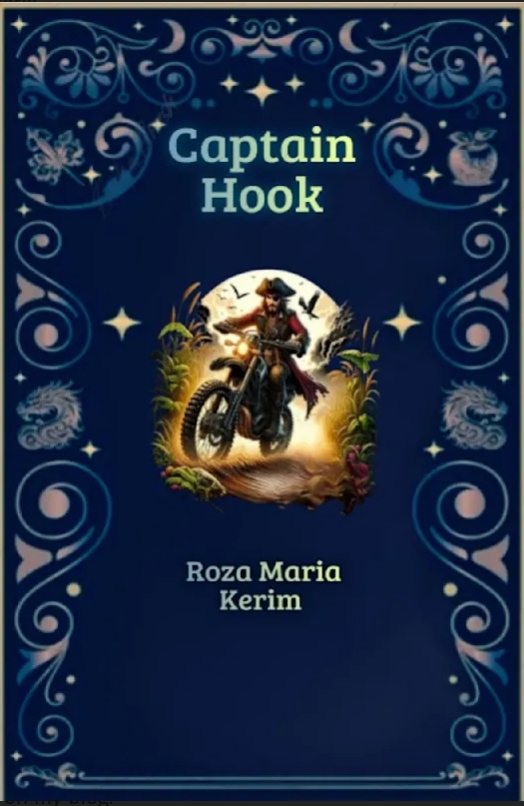
Captain Hook by Roza Maria Kerim is a poignant and humorous exploration of identity, memory, and the human desire for connection, cleverly presenting a modern retelling of Peter Pan.
Imagine being an amnesiac and having only one friend. Pretty bleak, if you ask me.
Now throw in wanting to adopt your arch nemesis, without either of you knowing about your true identities and trying to defeat an overpowered magician.
Captain Hook is not having a great day.
The protagonist’s amnesiac state serves as a metaphor for the search for belonging, echoing the timeless themes of J.M. Barrie’s classic.
The narrative’s central conflict is the protagonist’s struggle with his past and present identity. His encounters with Peter and Mrs. Bell challenge his perceptions of family and belonging. The protagonist’s interactions with Smee highlight his complex relationships and internal conflicts.
Hook creates an unexpected bond with Peter, revealing his softer side and vulnerability.
The character of Mrs. Bell, reminiscent of Tinkerbell, adds a layer of intrigue with her her confrontations with Hook and her protective relationship with Peter.
The mystery surrounding the real relationship between Hook and Peter adds layers of suspense and emotional depth to the narrative.
While Hook invites readers to reflect on themes of identity, memory, and the human desire for connection, it’s also is rich in humor and symbolism.
The unlikely protagonist’s journey is one of self-discovery, underscored by a persistent hope that even in a world of amnesia and misunderstanding, the past and present can find harmony.
Your CEO is Full of Sh!t by Lauren Dolman is a bold and empowering exploration of the challenges women face in corporate environments. It emphasises the pressure women face to conform to traditional corporate standards and encourages women to speak up and challenge the status quo, noting the importance of authenticity and integrity in leadership. The author highlights the normalization of misogyny and aggression in the workplace and urges readers to resist these pressures, challenge outdated norms and foster a more inclusive corporate culture.
Lauren Dolman shares personal anecdotes and insights to shed light on the various types of men encountered in the workplace, from those who are overtly dismissive to those who subtly undermine women’s progress while claiming to support gender equality.
The author emphasizes the importance of self-awareness and understanding one’s own identity, particularly in a misogynistic work environment. She reflects on her upbringing and how early experiences shaped her confidence and communication skills. She stresses the significance of staying true to oneself despite adversity and the challenges of being misunderstood or belittled.
The writing is conversational and engaging, making complex topics accessible and relatable. The author uses humor and personal stories to illustrate points, ensuring the book is an important but not heavy read. The style is direct and unapologetic, mirroring the call for authenticity and strength in the face of corporate challenges.
KEY POINTS:
The author encourages women to know themselves and stay true to their identity despite external pressures.
In this book, she emphasizes the importance of resilience in overcoming adversity.
She highlights the flirtatious and covertly unsupportive types of men who hinder women’s career progression.
She also urges women to remain authentic and confident, challenging the status quo and advocating for true equality and opportunity.
Overall, this book is a call to action for women to challenge the norms and advocate for genuine change within the corporate world. It provides valuable insights and practical advice while maintaining an engaging and approachable tone. Perfect for anyone looking to understand and navigate the intricacies of gender dynamics in the workplace.
Parents face many challenges, and feeding picky eaters is among the most daunting. Patty Canton’s Build A Better Eater – The Picky Eater Parent Survival Guide is a must-read for any parent grappling with a child’s selective eating habits. From the very first page, Canton empathizes with the struggle of preparing nutritious meals that go untouched, a frustration that resonates deeply with many.
I found this book particularly useful because it helped me recognize that my younger child is a picky eater. Understanding the underlying reasons behind his selective eating habits has been enlightening and has allowed me to approach his nutrition with a more informed and compassionate mindset.
Drawing from her own experiences with her children’s health and developmental issues, Canton emphasizes the critical role of nutrition in overall wellness. Her journey from frustration to success serves as a powerful testament to the transformative power of healthy eating habits. This personal touch adds a layer of authenticity and relatability to her guidance.
Canton’s expertise shines through as she delves into the complexities of picky eating, a problem that seems to be worsening in our fast-paced, convenience-driven world. She highlights the impact of modern dietary habits, where children develop a preference for processed foods and become ‘brand specific,’ making the task of feeding a family both challenging and stressful.
The book underscores that eating is a complex, behavioral task. The author provides a wealth of strategies to help parents navigate this maze, stressing the importance of perseverance and adaptability in implementing these approaches.
One of the most valuable aspects of this book is its practicality. The author offers a compact resource that parents can return to for reminders and motivation. She encourages starting from the child’s current level of food acceptance and refining the plan as needed.
Build A Better Eater – The Picky Eater Parent Survival Guide is an essential guide for parents seeking to improve their children’s eating habits. This book is not just about feeding your child; it’s about fostering a healthier, happier family dynamic.
This book is available on Amazon click HERE to BUY it NOW!
For further insights and practical tools, I highly recommend visiting Patty Canton’s official website.
It offers a wealth of information and resources, including printables that are incredibly helpful not only for managing picky eating but also for improving various other aspects of parenting.
These printables can be a game-changer for parents looking to enhance their skills and address different challenges with their kids.
Heart of the Storm by Grant Devers is a thrilling tale that masterfully combines elements of adventure, suspense, and human drama. Set against the treacherous backdrop of the Caribbean, this novel follows Bowne, a seasoned salvage expert, as he faces unforeseen dangers that test his limits.
The novel’s blurb sets the stage for an epic saga of courage and sacrifice, and the narrative delivers on this promise with vivid prose and heart-pounding action.
From the outset, Devers draws readers into a world where ancient secrets and modern-day perils collide.
The story begins with an intense scene aboard a Douglas DC-7 as it navigates the skies towards a perilous mission. The detailed descriptions of the aircraft and the tension-filled atmosphere immediately immerse the reader in the high-stakes environment.
Bowne, the protagonist, is portrayed with depth and nuance. His expertise and inner turmoil are convincingly depicted. The fear and foreboding he feels as the storm approaches add a layer of realism to his character, making him relatable and human.
Devers excels in creating a palpable sense of tension and danger. The descriptions of the brewing storm and the team’s meticulous preparations build suspense, keeping readers on the edge of their seats. The dynamic between the characters, particularly between Bowne and McMahon, is well-developed, highlighting the themes of teamwork and resilience.
The novel’s pacing is expertly managed, with moments of intense action interspersed with quieter, reflective scenes that allow for character development. As the plot unfolds, the team encounters greed, deceit, and treachery, adding complexity to their mission. The inclusion of a raging hurricane as a central obstacle heightens the stakes, making their journey even more harrowing.
One of the novel’s strengths is its ability to weave technical details seamlessly into the narrative. Devers’ knowledge of aviation and meteorology adds authenticity to the story, enhancing the reader’s immersion. The mission strategy discussions and the detailed depiction of the aircraft’s instruments and operations are particularly engaging for readers interested in these fields.
The vivid portrayal of San Fernandez adds another layer of depth to the narrative. The contrast between the lush banana and pineapple plantations and the poverty-stricken locals highlights the island’s complex history and present struggles. The legacy of European colonization, a bloody slave uprising, and the rule of the ruthless despot Renard paint a picture of an island trapped in a cycle of misfortune.
In St. Pierre, the dilapidated capital city, the oppressive atmosphere is palpable. The faded grandeur of the Hotel Imperiale and the noxious stench of decay set the stage for tense interactions, such as Bowne’s encounter with Miranda and the enigmatic Oliver Stratton.
The gritty underbelly of St. Pierre, with its dubious nightlife at the Hebe Haven Club, adds a sense of foreboding and danger. The shadowy confines and pulsating rhythms provide a stark contrast to the oppressive reality of life in San Fernandez, hinting at darker revelations yet to unfold.
Armored vehicles line the streets, soldiers stand at the ready, and the palpable sense of impending chaos grips the Base. Frustrated and on edge, Bowne is driven by a sense of urgency as the looming hurricane, Sandy, presents a conundrum that refuses to yield to easy prediction.
Born of West Indian heritage, Bowne’s skepticism of the forecasts and intuitive understanding of hurricanes spur him to action, guided by a gut feeling that defies scientific reasoning.
Bowne’s insistence on local warnings is met with Klein’s dismissive attitude towards the island’s lackadaisical response to impending disasters. The abrupt dismissal of a key character adds another layer of intrigue, hinting at deeper currents of political upheaval that mirror the gathering storm.
The clash of wills and beliefs plays out as the fate of San Fernandez hangs in the balance.
Devers paints a vivid picture of the impending disaster, describing Sandy as a monstrous force of nature, a harbinger of destruction unlike anything seen before.
It was a nice surprise to see that there was a Greek character in the novel. This added a layer of cultural diversity and richness to the narrative, reflecting the global nature of the story and the varied backgrounds of those involved in the story.
The novel takes a dramatic turn as Bowne finds himself in the throes of a brutal conflict as the chaos of war rages around him.
Soon, Bowne is confronted with the harsh reality of the devastation around him which makes him realize the fragility of life and the brutal truth of survival in a world torn apart by violence.
Determined to defy the odds, he carves out a path to freedom amidst the chaos and destruction. However, despite the temptation to escape, Bowne knows he must find his loved ones first.
Heart of the Storm is more than just an adventure story; it is a testament to human perseverance and the indomitable spirit. The themes of courage, sacrifice, and redemption are explored through the characters’ struggles and triumphs.
This gripping and evocative novel that will captivate readers with its blend of action, suspense, and emotional depth. Devers has crafted a compelling tale that resonates long after the final page is turned.
By the novel’s conclusion, readers are left with a deep appreciation for the resilience of the human spirit in the face of overwhelming odds. I particularly loved the touching finale, which provided a satisfying emotional resolution that left a lasting impact.
In The Dragon in the Closet comic book series, Orin Bean has terrible luck and a problem with monsters. Also, his Nana seems to be a powerful witch.
Orin is really a perfectly normal boy who just happens to have a dragon in the closet. What kid wouldn’t want that?
In The Dragon in the Closet, The Water Devil, Issue #4 Orin Bean and Dragon continue their journey north to the Realm of the Ice Goblins in their quest to undo Orin’s curse. However, a new and terrifying monster is chasing them.
Will they survive the attack of this powerful creature? Will they ever meet up with Orin’s Nana and his friend Lucy?
Winner of 2022 Silver Literary Titan Book Award. Winner of 2023 Outstanding Creator Award
My review
In the realm of children’s literature, it is a rare delight to stumble upon a story that not only captivates the imagination but also whisks you away on a whirlwind of adventure and magic. The Dragon in The Closet is precisely such a book, perfectly tailored for young readers aged 7-9.
The story centers around Orin Bean, a seemingly ordinary boy with an extraordinary burden—a family curse aiming for his demise. The discovery of a dragon hiding in his closet marks a pivotal turn in his life.
This dragon, imprisoned by Orin’s Nana, a powerful witch of her own, was meant to protect him. What follows is a thrilling escapade that sees Orin, his Nana, and his best friend Lucy navigating a world brimming with supernatural entities—from ghosts to water devils, and enchanted trees to magical air bubbles.
The artwork in The Dragon in The Closet deserves special mention. The panels are beautifully crafted, with an enchanting blend of dark greens and blues that perfectly capture the mystical and suspenseful atmosphere of the story. Each page of the comic is a visual treat, enhancing the narrative and bringing the magical world to life in a way that is both engaging and visually stimulating.
The story is fast-paced and filled with suspense, making it a page-turner that’s hard to put down. The author and creator masterfully intertwines themes of bravery, friendship, and the battle between good and evil, all while maintaining a light-heartedness suitable for its intended audience.
The Dragon in The Closet is an adventure that young readers will find both thrilling and magical. The accolades it has received, including the 2022 Silver Literary Titan Book Award and the 2023 Outstanding Creator Award, are well deserved.
For parents and guardians looking to ignite a passion for reading in their children, The Dragon in The Closet is a must-have on their bookshelves. It promises not only to entertain but also to inspire with its vivid storytelling and stunning artwork.
Click here or here to discover this new exciting chapter of the award winning series!
Intriguing from start to finish. ‘The Chalk Man’ is a fast paced chilling story which had me wanting to keep turning the pages to find out what happens next. The writings style is nice and the plot well build. I’d like to read more from this author.
First, the good news. This is a well written book. The author’s writing style is nice and the descriptions are beautiful. Where this book fails is the storyline. It starts as a mystery book, at least that’s what the title and the first chapter imply, but any sense of mystery is being evaporated as the narrative continues. The first 40% of the book is frittered away in the main character’s childhood memories that seem to have no connection to the main event of the story and that leaves the reader confused.









 A book and a cup of coffee